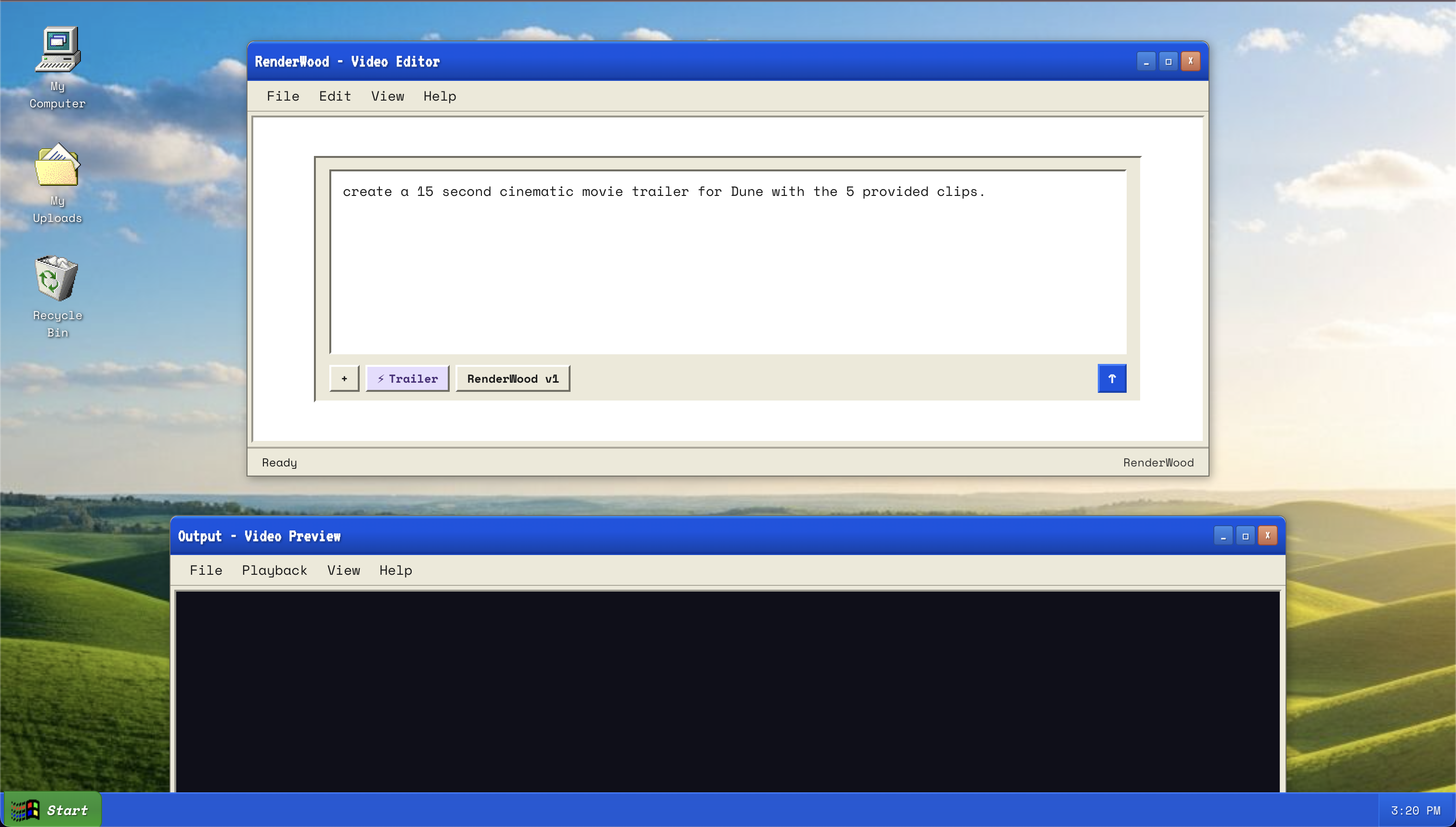
prompt: create a 15 second cinematic movie trailer for Dune with the 5 provided clips.
Frontend design
Renderwood is an agentic video editor. You upload your clips, write a prompt, and get back a rendered MP4. That's it. It handles the transitions, color grading, title cards, background music, and cinematic letterboxing. The output above is from one prompt and five raw clips.
It's built for anyone who needs a polished trailer fast. Useful for product launches, short films, and hackathon demos.
The Pipeline
Renderwood runs two AI agents: Kimi K2.5 for prompt expansion, then Claude Sonnet 4.5 for code execution and rendering.
The user's enters a short prompt like "create a 15 second cinematic trailer for Dune with these 5 clips", which goes into Kimi K2.5 first. It expands that into a detailed production brief with a shot by shot timeline, explicit transition types (cross-dissolve, flash-to-white), CSS filter values for cinematic color grading, typography specs (Bebas Neue, 120px, uppercase, white with drop shadow), and which music track to use.
That enhanced brief goes to an agent built with Claude Agents SDK. Claude reads the spec, loads Remotion domain knowledge via the skills system, and writes React components for each scene. The agent takes on average 50 turns to produce the final output.
Skills
The Claude agent doesn't come pre-loaded with Remotion knowledge. It learns what it needs per job.
The Remotion template project ships with a .claude/skills/remotion-best-practices/ folder containing 30+ markdown rule files: transitions.md, audio.md, text-animations.md, timing.md, fonts.md, light-leaks.md, and more. The agent's system prompt instructs it to call Skill("remotion-best-practices") before touching any code, then load the specific sub-rules needed for that job.
The rules are specific enough to be immediately useful. transitions.md has actual TransitionSeries code patterns. timing.md covers spring animations and easing curves. The agent doesn't have to rediscover Remotion conventions from scratch on every job.
Sandboxing
Every render job runs in complete isolation. When a job starts, the orchestrator clones the entire Remotion template into remotion_jobs/run_N/. The Claude agent's working directory is set to that job folder. It cannot read or write anything outside it.
There are two permission layers on top of that. First, allowed_tools is constrained to [Skill, Read, Write, Edit, Bash, Glob, Grep] — the agent can't use tools that aren't on the list. Second, the Remotion project ships with a settings.local.json that pre-approves only specific bash commands: npx remotion render, npm run build, ffprobe, node -e, lsof. The agent can render videos and inspect files, but the permission surface is narrow.
Styles and Music
Renderwood has two video styles: GENERAL and TRAILER. Each style is a completely different system prompt, which changes the production brief the agent receives.
TRAILER mode enforces a cinematic playbook: three-act structure, 2.39:1 letterbox framing, flash-to-white transitions, Ken Burns push-ins, spring-animated title cards, and explicit music sync points.
Three background tracks ship with every job (dramatic, mysterious, speeding_up_dramatic). The prompt enhancer picks the best fit based on user uploaded visuals.